
Previous Residents at a North Carolina Address
North Carolina addresses leave several kinds of history. Start with deeds for ownership, then compare directories, census schedules, and family records for household clues. Each source has its own custodian and date range; deed and directory coverage is local.
| Source | Years It Covers | Where Held | What It Shows |
|---|---|---|---|
| County deed books and indexes | From county creation through present; online start varies by county | County Register of Deeds originals; State Archives indexes and microfilm | Grantor and grantee, document type, legal description, date, and chain of title |
| North Carolina birth records | State copies from 1913; older records route to the county | NC Vital Records, county Register of Deeds, or State Archives by era | Names, parents, date, place, and certificate details subject to access rules |
| North Carolina death records | State copies from 1930; delayed records can reach 1909; earlier records at Archives | NC Vital Records or State Archives, according to year | Decedent, event place and date, informant, and residence clues on the certificate |
| Marriage and divorce records | State marriage copies from 1962 and divorce copies from 1958; local earlier records vary | Register of Deeds for marriage; Clerk of Superior Court for divorce | Names, dates, places, license or case details, and related people when recorded |
| City directories | City-specific runs, often from the late 1800s or 1900s; exact years vary | Local libraries, university collections, and digitized catalogs | Annual name, address, occupation, spouse, and publisher-specific marks |
| Reverse or criss-cross directories | City-specific volumes; no statewide run of years was verified | Local library or university collection | Address-to-occupant or business entries for the printed year |
| Federal census schedules | 1790-1950 released under the 72-year rule; 1890 schedules mostly destroyed | State Archives microfilm, libraries, and census collections | Household members, age, relationship, occupation, birthplace, and geography |
| Sanborn fire-insurance maps | City and sheet specific; many towns have selected historic years | State Archives, university map rooms, and local libraries | Building footprint, use, materials, block context, and sometimes street numbers |
| Permit and code files | Local retention and online depth vary | City or county inspections/code office | Alteration, demolition, project date, applicant, owner, or contractor as recorded |
| Assessor tax cards and rolls | County-specific historical depth | County assessor or GIS office | Owner, situs and mailing address, value, exemptions, parcel, and deed reference |
For recent ownership, pair a tax card with the deed. For older households, compare a town directory with a nearby census year, then use probate or obituaries as family-history leads.
North Carolina Vital Records has no free web search of certificates. Current state copies begin in 1913 for births, 1930 for deaths, 1962 for marriages, and 1958 for divorces. Older births and marriage licenses route to the county Register of Deeds, earlier deaths to the State Archives, and older divorces to the filing county Clerk of Court. North Carolina marriage bonds ran from 1741 to 1868, though they were not required in every case. Applications can be made online, by mail, phone, or in person; the current state search fee is $24 for each three-year period, including one copy if found, and each additional copy is $15. Certified copies require identity and eligibility under N.C. Gen. Stat. §130A-93(c), while an uncertified copy is informational. See the official ordering instructions, fee schedule, and Chapter 130A access rules before requesting a record.
North Carolina Deed Years Vary by County
There is no single North Carolina deed-index start year. Each county Register of Deeds has its own online vendor and image coverage, and exact cutoff years must be checked in the selected county portal. The NCARD county directory is the route to the correct office, not a guarantee that its website contains every deed.
NCARD county profiles give office address, phone, email, website, eRecording, NCDAVE, and fraud-alert information. Services are local. Indexes may be free while images or copies cost money. If web coverage ends, call, mail, or visit the Register of Deeds and ask about older books or microfilm. The State Archives retention schedule does not set one online cutoff for all 100 counties.
North Carolina Parcel Records for Past Residents
Anchor the older search to the current parcel ID and legal description. A tax card may show situs and mailing addresses, deed reference, acreage, subdivision, and sale date. The statewide North Carolina OneMap viewer helps place the parcel; county assessors hold local card detail.
North Carolina parcel boundaries can change after a split or merger. Compare lot, block, acreage, adjoining owners, and plat at each change. For current address and map fields, see the North Carolina street directory; here the parcel keeps one property's older deed chain together.
Trace Past Residents Through North Carolina Deeds
A North Carolina deed search follows the ownership of one parcel, which can reveal when names and land descriptions changed. First use the current tax record to identify the owner and legal description. Then search the county Register of Deeds index backward, using the seller from one transfer as the grantee in the earlier one. This is an ownership trail. It does not prove every person who lived on the property.
The Wake County Register of Deeds CRPI search is one county example of an online index; other North Carolina counties use their own systems and coverage. The Wake screen below is not a statewide deed portal.
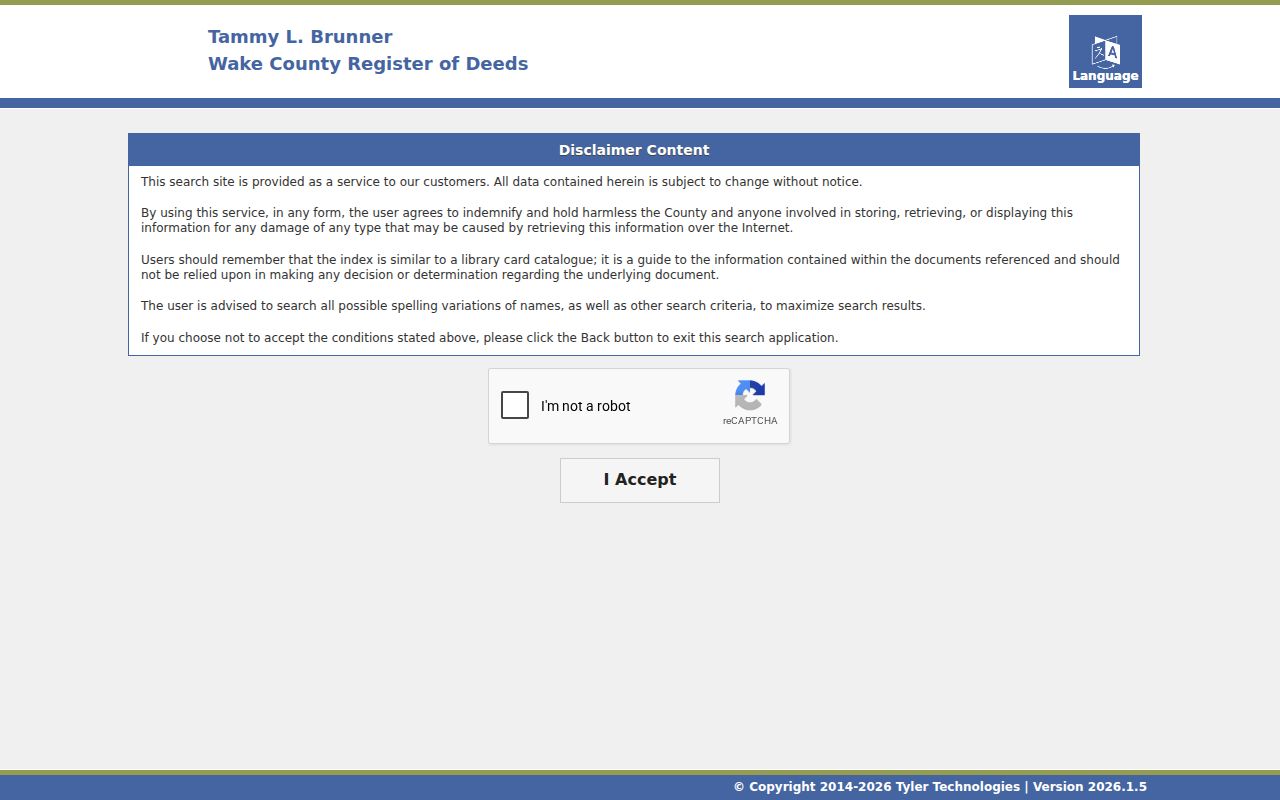
For an address outside Wake County, use NCARD to select the Register of Deeds that holds that parcel's records.
Deed tools vary by vendor, so fields may be absent or named differently. Image access, redactions, sorting, and copy charges also vary. The table shows local search options; a result may also contain these details:
| Index Field or Control | Type | Required | North Carolina Search Note |
|---|---|---|---|
| County selector | Map or dropdown | Yes | Select the county that holds the parcel. |
| Party, grantor, or grantee name | Text | Usually no | Search the role tab or name field; exact and partial behavior varies. |
| Instrument or document number | Text | No | Number format is county-specific. |
| Book and page | Paired text | No | Use when a deed reference appears on a parcel card. |
| Document type | Dropdown | No | Local lists may include deeds, plats, liens, and related instruments. |
| Recording date range | Date pair | No | Narrow a broad name search where offered. |
| Legal description or PIN | Text | No | Available in some systems; local parcel formats vary. |
| Search or Reset | Buttons | Search when needed | Names and page controls vary by vendor. |
- Grantor and grantee, party role, document type, and recording date.
- Instrument number, book/page, execution date when indexed, and legal description or PIN.
- Consideration or excise-tax field when supplied, related prior instrument, and image link or status.
- Any access restriction or redaction notice shown with the record.
- Write down the parcel ID, current owner, site address, and complete legal description from the tax card. Keep the mailing address separate.
- In the correct county index, search the current owner as grantee. Narrow by recording date or document type if common names create many results.
- Open the deed and note its grantor, recording number, date, book/page, parcel reference, and legal description. Compare the legal description with the present parcel.
- Search that grantor as grantee to locate the earlier purchase, then repeat while the description and land boundaries still match.
- If the chain reaches a split, merger, missing image, or online cutoff, branch to the parent tract and ask the county office or State Archives for books, indexes, and microfilm.
- Grantor and grantee
- The grantor conveys an interest; the grantee receives it. Index tabs often separate the two roles.
- Chain of title
- The sequence of recorded transfers that links one owner to an earlier owner for the same land.
- Legal description
- The written land boundaries or lot reference. Older deeds may use this instead of a street number.
- Criss-cross directory
- An address-first directory that may list an occupant or business for the town and year of its volume.
North Carolina Archives for Past Residents
The North Carolina State Archives, established in 1903, holds government and cultural material from across the state. Its county-record collections cover almost all 100 current counties and six defunct counties, but original deed and will books usually remain with county offices. The Archives has deed indexes and microfilm copies for many counties, plus maps, estate papers, tax records, voter materials, newspapers, and family collections. The Raleigh Search Room is at 109 E. Jones Street; the research contact number is 919-814-6840.
Estate files are arranged by family surname, linking probate and land research. County-copy census films cover 1790 through 1930 except for the destroyed 1890 schedules. Search the Archives catalog or Research Room, and browse the North Carolina Digital Collections for scans.
County record survival and access differ, and no statewide courthouse-loss list was located. For a missing deed book or index, ask the county Register of Deeds and State Archives about originals, copies, microfilm, or related series. The State Library's Tracking North Carolina Ancestors guide covers wills, land, voter registrations, taxes, and other historical sources.
North Carolina Census and Directory Years
In North Carolina, a city directory is usually an annual town snapshot; a census is a federal household snapshot taken on a different cycle. Pairing them can narrow a period when a family used one address. North Carolina directories are held town by town, not in one statewide series, and their front matter explains the publisher's symbols for spouse, widow, renter, owner, boarder, or cross-reference.
When a directory entry is located, preserve its printed fields before reading it as a household clue:
- Printed year, title or publisher, city or county, and page number.
- Name, surname, given name or initials, and spouse in parentheses when shown.
- Occupation, employer or business, and street address or house number.
- Owner or renter mark, widow, boarder or lodger note, and “see” cross-reference.
- Street index, classified listing, phone number in later volumes, and the publisher's abbreviation key.
- Confirm the county and town printed in the volume; nearby places can share a postal name.
- Copy the exact address, name, spouse, occupation, page, and publisher; check the abbreviation key.
- Compare nearby years for a moved address, household change, or “removed” cross-reference.
- Match the entry to a released census year. Records are public through 1950; most 1890 schedules were destroyed.
- Use deeds for land ownership. A household member may appear in a directory or census without owning the parcel.
- Ask a local library, university, or State Archives for an unscanned year or missing catalog record.
The State Library's ancestor research guide and the DigitalNC collection directory are good routes to historical finding aids and digitized local materials. Check a local library catalog for the exact town, title, and year run before assuming a directory is available.
North Carolina Road Changes in Address Histories
An old house number can fail in a current map when a county or town renamed a road, changed a number, or used a different grid. North Carolina local road rules vary. Wilmington and New Hanover County use the Cape Fear River and Market Street as directional base lines; other counties rely on their own E911 and GIS systems. Do not carry Wilmington's numbering pattern across the state.
The Wilmington addressing manual is local. Ask the relevant GIS, planning, or road-naming office for an old-to-current link, ordinance, public notice, or street-centerline record. Keep both street forms with the map sheet, lot and block, and parcel number. If parcels split or merged, follow the parent tract and later branches.
Sanborn maps cover selected cities and years; sheets can show a building footprint, use, materials, block, and sometimes a street number, but not occupants. Ask the State Archives or local library about the town and sheet. Search local permit and code files by current and former address or parcel; when online history ends, ask the office by phone, at the counter, or in writing. A Chapter 132 request can identify a public file, though retention and response times vary.
North Carolina Probate for Past Residents
North Carolina probate files may show land moving through an executor's deed, administrator's deed, partition, or inheritance rather than a standard sale. The county Clerk of Superior Court keeps estate and probate files. The public eCourts Portal is free, but it is not the official court record. A public terminal in any county can search statewide case information, while the paper file stays with the filing county clerk. Ask that clerk about copies, archived material, and current fees. Court files have public and confidential parts.
An obituary can supply a spouse, children, residence, funeral home, church, or relatives who help explain a deed transfer. Local newspapers, library obituary indexes, the State Archives, and digitized collections offer different date and title coverage. DigitalNC is one search route, while a local library can check microfilm and clipping files that are not online.
Use those names as leads, then verify the land change in a deed, probate file, or eligible certificate. An obituary is not a title record, and an heir named in a notice is not automatically the person who received the parcel.
Past Households of Previous North Carolina Residents
A North Carolina deed chain follows land; older address books and census schedules add household evidence. Search an exact street address in a reverse directory when one exists, then check the matching alphabetical entry and its year. Directories can omit rural residents, children, people listed under a spouse, transient people, and residents between editions. A missing name is not proof that nobody lived there.
Local libraries, university collections, and State Archives hold different runs and formats. The North Carolina Directory Book page covers the directory collections themselves. For a parcel history, use the address, year, and name together, then verify any family or ownership link in another record.
Lawful use. Research into North Carolina's past residents is for house history, family history, and personal curiosity. Do not use old addresses or names to track, harass, or intimidate a living person.